Determinants & Inverses
The determinant tells you whether a matrix can be undone — and if it can, the inverse tells you exactly how.
The 2×2 determinant and inverse
For $A=\begin{pmatrix}a&b\\c&d\end{pmatrix}$, the determinant is $\det(A)=|A|=ad-bc$. If $\det(A)\neq0$, $A$ is non-singular and has an inverse; if $\det(A)=0$, $A$ is singular and has no inverse.
$$A^{-1}=\dfrac{1}{ad-bc}\begin{pmatrix}d&-b\\-c&a\end{pmatrix},$$ $$AA^{-1}=A^{-1}A=I$$ Swap the leading-diagonal entries, negate the other two, and divide by the determinant.
$\det(A)=3(4)-1(2)=10$.
The 3×3 determinant
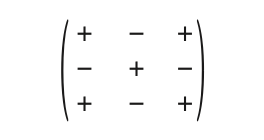
$$\det(A)=a_{11}\begin{vmatrix}a_{22}&a_{23}\\a_{32}&a_{33}\end{vmatrix}-a_{12}\begin{vmatrix}a_{21}&a_{23}\\a_{31}&a_{33}\end{vmatrix}+a_{13}\begin{vmatrix}a_{21}&a_{22}\\a_{31}&a_{32}\end{vmatrix}$$ Each $2\times2$ determinant is the minor formed by deleting the row and column of the entry it multiplies. Signs alternate $+,-,+$ across the row.
$\det(A)=1\begin{vmatrix}1&4\\6&0\end{vmatrix}-2\begin{vmatrix}0&4\\5&0\end{vmatrix}+3\begin{vmatrix}0&1\\5&6\end{vmatrix}$
$=1(0-24)-2(0-20)+3(0-5)=-24+40-15=1$
The 3×3 inverse
1. Find $\det(A)$. 2. Form the matrix of cofactors $C_{ij}=(-1)^{i+j}\times(\text{minor}_{ij})$. 3. Transpose to get the adjugate, $\text{adj}(A)=C^T$. 4. $A^{-1}=\dfrac{1}{\det(A)}\text{adj}(A)$.
$\det(M)=2(3-1)-1(3-0)+0=4-3=1$.
Cofactors: $C_{11}=2,\ C_{12}=-3,\ C_{13}=1,\ C_{21}=-3,\ C_{22}=6,\ C_{23}=-2,\ C_{31}=1,\ C_{32}=-2,\ C_{33}=1$.
Transposing the cofactor matrix gives the adjugate — here $M$'s cofactor matrix happens to be symmetric, so $\text{adj}(M)$ equals it directly:
Don't forget to transpose the cofactor matrix before dividing by the determinant — the untransposed matrix of cofactors is not the inverse (except when it happens to be symmetric, as above).
Exam-style questions
Question 1 4 marks
Find $\det(A)$ for $A=\begin{pmatrix}1&2&-1\\3&0&2\\4&-1&3\end{pmatrix}$.
$\det(A)=1\big(0(3)-2(-1)\big)-2\big(3(3)-2(4)\big)+(-1)\big(3(-1)-0(4)\big)$ (M1)
$=1(0+2)-2(9-8)+(-1)(-3-0)=2-2+3=3$ (M1, A1)
So $\det(A)=3$, confirming $A$ is non-singular. (A1)
Question 2 5 marks
Find $A^{-1}$ for $A=\begin{pmatrix}5&3\\2&1\end{pmatrix}$.
$\det(A)=5(1)-3(2)=-1$ (M1, A1)
(M1, A1, A1)