nth Roots of a Complex Number
Every complex number has exactly $n$ distinct $n$th roots, evenly spaced around a circle — including the special case of the roots of unity.
Solving $z^n=a+bi$
To solve $z^n=w$ for a given complex number $w=re^{i\theta}$:
- Write $w$ in exponential form, but keep every valid argument: $w=re^{i(\theta+2k\pi)}$ for any integer $k$, not just the principal value.
- Write $z=\rho e^{i\phi}$ and substitute: $\rho^ne^{in\phi}=re^{i(\theta+2k\pi)}$.
- Equate moduli: $\rho^n=r$, so $\rho=r^{1/n}$ (the positive real $n$th root).
- Equate arguments: $n\phi=\theta+2k\pi$, so $\phi=\dfrac{\theta+2k\pi}n$.
- Substitute $k=0,\pm1,\pm2,\ldots$ until you have generated exactly $n$ distinct values of $\phi$ in the range $(-\pi,\pi]$ — every complex number has exactly $n$ distinct $n$th roots.
Write $8i=8e^{\frac\pi2 i}$, or more fully $8e^{i\left(\frac\pi2+2k\pi\right)}$ for integer $k$.
If $z=\rho e^{i\phi}$ satisfies $z^3=8i$, then $\rho^3=8\Rightarrow\rho=2$, and $3\phi=\dfrac\pi2+2k\pi\Rightarrow\phi=\dfrac\pi6+\dfrac{2k\pi}3$.
$k=0$: $\phi=\dfrac\pi6$. $\quad k=1$: $\phi=\dfrac\pi6+\dfrac{2\pi}3=\dfrac{5\pi}6$. $\quad k=-1$: $\phi=\dfrac\pi6-\dfrac{2\pi}3=-\dfrac\pi2$.
Each of these lies in $(-\pi,\pi]$, and $k=2$ would give $\phi=\dfrac\pi6+\dfrac{4\pi}3=\dfrac{3\pi}2$, outside the range and in fact identical (mod $2\pi$) to the $k=-1$ root — so exactly three roots exist: $z=2e^{\frac\pi6 i},\;2e^{\frac{5\pi}6 i},\;2e^{-\frac\pi2 i}$.
Roots of unity
The solutions of $z^n=1$ are called the $n$th roots of unity. Applying the method above with $w=1=e^{i\cdot0}$ gives $\rho=1$ and $\phi=\dfrac{2k\pi}n$, so the $n$ roots are
$$z=e^{\frac{2k\pi}{n}i}, \qquad k=0,1,2,\ldots,n-1$$
Writing $\omega=e^{\frac{2\pi}{n}i}$ for the root with $k=1$, every root of unity can be expressed as a power of $\omega$: the full set is $1,\omega,\omega^2,\ldots,\omega^{n-1}$.
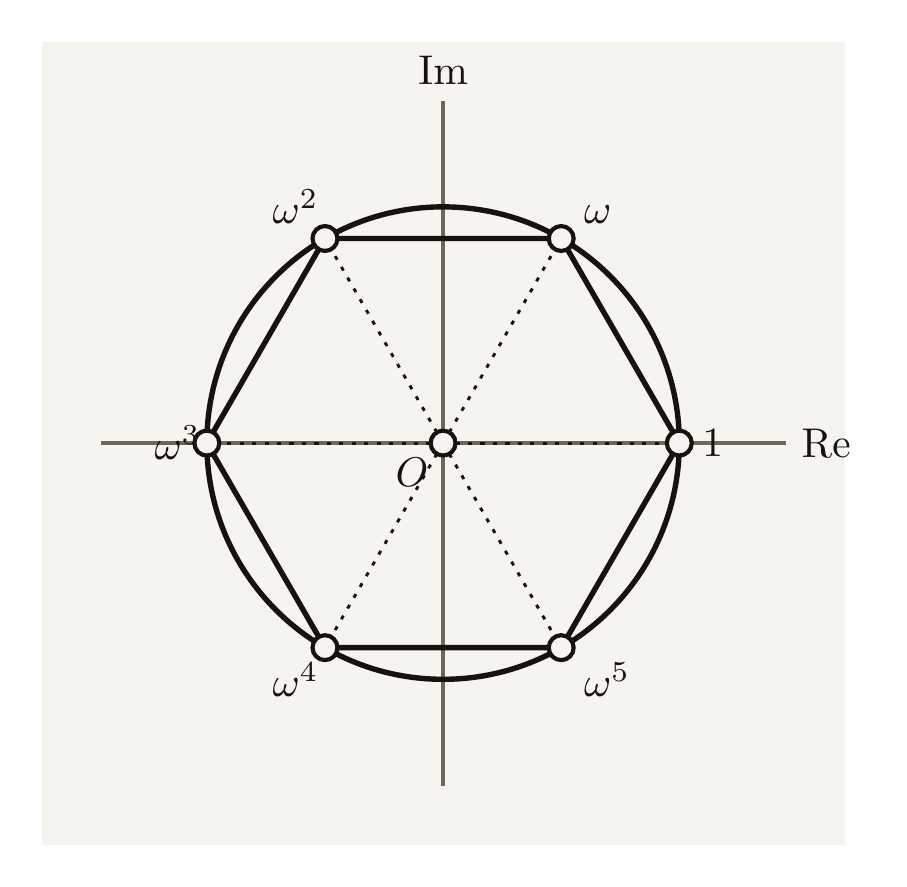
For $n\geq2$, the sum $1+\omega+\omega^2+\cdots+\omega^{n-1}=0$. This follows immediately from the geometric series formula: $1+\omega+\cdots+\omega^{n-1}=\dfrac{1-\omega^n}{1-\omega}$, and $\omega^n=1$ (since $\omega$ is an $n$th root of unity), so the numerator is zero while the denominator is non-zero (as $\omega\neq1$ for $n\geq2$).
The 5th roots of unity are $z=e^{\frac{2k\pi}5 i}$ for $k=0,1,2,3,4$, i.e. $1,\;e^{\frac{2\pi}5 i},\;e^{\frac{4\pi}5 i},\;e^{-\frac{4\pi}5 i},\;e^{-\frac{2\pi}5 i}$ (the last two rewritten into the principal range).
For $(z+2)^5=1$, let $u=z+2$; then $u^5=1$ has exactly the roots found above. So $z=u-2$ for each value of $u$: $z=-1,\;-2+e^{\frac{2\pi}5 i},\;-2+e^{\frac{4\pi}5 i},\;-2+e^{-\frac{4\pi}5 i},\;-2+e^{-\frac{2\pi}5 i}$.
Exam-style questions
Question 1 6 marks
Find, in the form $re^{i\theta}$ with $-\pi<\theta\leq\pi$, the four fourth roots of $z=-16$.
$-16=16e^{i\pi}$, or more generally $16e^{i(\pi+2k\pi)}$. (M1)
$\rho^4=16\Rightarrow\rho=2$; $4\phi=\pi+2k\pi\Rightarrow\phi=\dfrac\pi4+\dfrac{k\pi}2$. (M1, A1)
$k=0:\phi=\dfrac\pi4$; $k=1:\phi=\dfrac{3\pi}4$; $k=-1:\phi=-\dfrac\pi4$; $k=-2:\phi=-\dfrac{3\pi}4$. (M1, A1)
Roots: $2e^{\frac\pi4 i},\,2e^{\frac{3\pi}4 i},\,2e^{-\frac\pi4 i},\,2e^{-\frac{3\pi}4 i}$. (A1)
Question 2 5 marks
The complex number $\omega=e^{\frac{2\pi}7 i}$ is a 7th root of unity. Find the value of $1+\omega+\omega^2+\omega^3+\omega^4+\omega^5+\omega^6$, and hence find the value of $\omega+\omega^2+\omega^3+\omega^4+\omega^5+\omega^6$.
Since $\omega$ is a 7th root of unity ($\omega\neq1$), the sum of all 7 roots is zero: $1+\omega+\omega^2+\cdots+\omega^6=0$. (M1, A1)
Subtracting $1$ from both sides: $\omega+\omega^2+\cdots+\omega^6=-1$. (M1, A1, A1)
Question 3 7 marks
Solve $(z-1)^5=32$, giving your five answers in the form $x+iy$ where appropriate, and in exact form where possible.
Let $u=z-1$, so $u^5=32=32e^{i\cdot0}$, i.e. $32e^{i(0+2k\pi)}$. (M1)
$\rho^5=32\Rightarrow\rho=2$; $5\phi=2k\pi\Rightarrow\phi=\dfrac{2k\pi}5$, giving $\phi=0,\pm\dfrac{2\pi}5,\pm\dfrac{4\pi}5$. (M1, A1)
So $u=2,\;2e^{\pm\frac{2\pi}5 i},\;2e^{\pm\frac{4\pi}5 i}$, and $z=u+1$: $z=3$, and the other four as $1+2e^{\pm\frac{2\pi}5 i}$ and $1+2e^{\pm\frac{4\pi}5 i}$ (left in exponential-shifted form, or converted numerically). (M1, A1, A1)