Multiplying & Dividing Complex Numbers
Exponential form turns multiplying and dividing complex numbers into ordinary laws of indices — moduli multiply, arguments add.
Recall from the previous lesson that any complex number can be written $z=re^{i\theta}$, where $r=|z|>0$ and $\theta=\arg z$ satisfies $-\pi<\theta\leq\pi$.
Multiplying and dividing in exponential form
Exponential form turns the modulus-argument multiplication/division rules into ordinary laws of indices. If $z_1=r_1e^{i\theta_1}$ and $z_2=r_2e^{i\theta_2}$:
$$z_1z_2=r_1r_2e^{i(\theta_1+\theta_2)}$$
$$\frac{z_1}{z_2}=\frac{r_1}{r_2}e^{i(\theta_1-\theta_2)}$$
In words: moduli multiply (or divide) as normal, while arguments simply add (or subtract) — the exponent behaves exactly like a real-number exponent, because $e^{i\theta_1}\cdot e^{i\theta_2}=e^{i(\theta_1+\theta_2)}$ is inherited directly from the ordinary law of indices $e^ae^b=e^{a+b}$, extended to complex exponents.
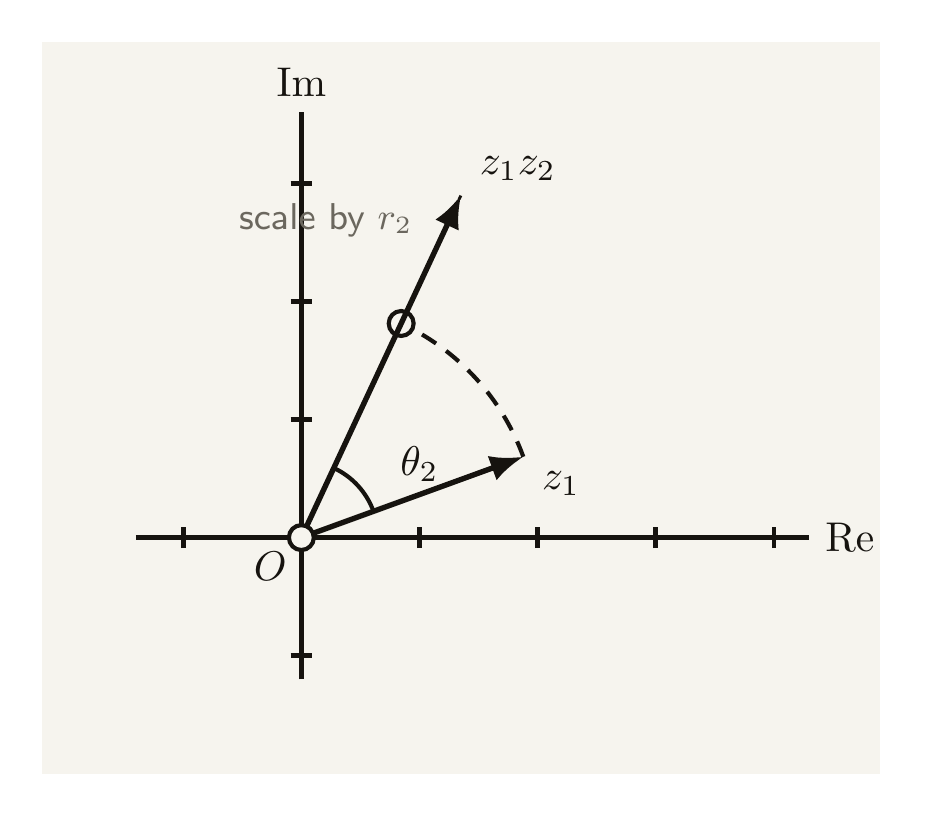
$z_1z_2=(5\times2)e^{i\left(\frac\pi3+\frac\pi4\right)}=10e^{\frac{7\pi}{12}i}$.
Since $\dfrac{7\pi}{12}$ already lies in $(-\pi,\pi]$, no adjustment is needed. Converting: $10e^{\frac{7\pi}{12}i}=10\left(\cos\dfrac{7\pi}{12}+i\sin\dfrac{7\pi}{12}\right)\approx10(-0.259+0.966i)\approx-2.59+9.66i$.
$\dfrac{z_1}{z_2}=\dfrac63\,e^{i\left(\frac{5\pi}6-\left(-\frac{2\pi}3\right)\right)}=2e^{i\cdot\frac{3\pi}{2}}$.
The angle $\dfrac{3\pi}2$ is outside $(-\pi,\pi]$, so subtract $2\pi$: $\dfrac{3\pi}2-2\pi=-\dfrac\pi2$. Therefore $\dfrac{z_1}{z_2}=2e^{-\frac\pi2 i}$.
Combine moduli: $\dfrac{4\times3}{2}=6$. Combine arguments: $\dfrac{7\pi}9-\dfrac{5\pi}{18}-\dfrac\pi2=\dfrac{14\pi}{18}-\dfrac{5\pi}{18}-\dfrac{9\pi}{18}=\dfrac{0}{18}=0$.
So the expression simplifies to $6e^{0i}=6$.
Exponential form is the natural language for everything else in this chapter — De Moivre's theorem, $n$th roots, and sums of trigonometric series all become almost mechanical once you're fluent in treating $e^{i\theta}$ like an ordinary exponential.
Exam-style questions
Question 1 6 marks
Given $z_1=7e^{\frac{11\pi}{12}i}$ and $z_2=\sqrt7\,e^{\frac{\pi}{6}i}$, find $z_1z_2$ and $\dfrac{z_1}{z_2}$, giving both answers in the form $re^{i\theta}$ where $-\pi<\theta\leq\pi$.
$z_1z_2$: modulus $7\sqrt7$; argument $\dfrac{11\pi}{12}+\dfrac\pi6=\dfrac{11\pi}{12}+\dfrac{2\pi}{12}=\dfrac{13\pi}{12}$, which is outside $(-\pi,\pi]$, so subtract $2\pi$: $\dfrac{13\pi}{12}-2\pi=-\dfrac{11\pi}{12}$. So $z_1z_2=7\sqrt7\,e^{-\frac{11\pi}{12}i}$. (M1, A1, M1, A1)
$\dfrac{z_1}{z_2}$: modulus $\dfrac{7}{\sqrt7}=\sqrt7$; argument $\dfrac{11\pi}{12}-\dfrac\pi6=\dfrac{11\pi}{12}-\dfrac{2\pi}{12}=\dfrac{9\pi}{12}=\dfrac{3\pi}4$, already in range. So $\dfrac{z_1}{z_2}=\sqrt7\,e^{\frac{3\pi}{4}i}$. (A1, A1)
Question 2 7 marks
Given that $z=2e^{\frac{\pi}{5}i}$ and $|zw|=8$ with $\arg(zw)=\pi$, use geometric reasoning to find $w$ in exponential form.
Since $|zw|=|z||w|$, we need $2|w|=8$, so $|w|=4$. (M1, A1)
Since $\arg(zw)=\arg z+\arg w$, we need $\dfrac\pi5+\arg w=\pi$ (using the given value of $\arg(zw)$ directly, since it's already stated in the principal range), so $\arg w=\dfrac{4\pi}5$. (M1, A1, A1)
$w=4e^{\frac{4\pi}{5}i}$. (A1)