Argand Diagrams & Modulus/Argument
Every complex number is a point on a plane — its distance from the origin and its angle from the real axis describe it just as completely as its real and imaginary parts.
Plotting complex numbers geometrically
A complex number $z=a+bi$ can be represented as the point $(a,b)$ on a coordinate plane called the Argand diagram. The horizontal axis is the real axis and the vertical axis is the imaginary axis. Equivalently, $z$ can be represented by the position vector from the origin to $(a,b)$.
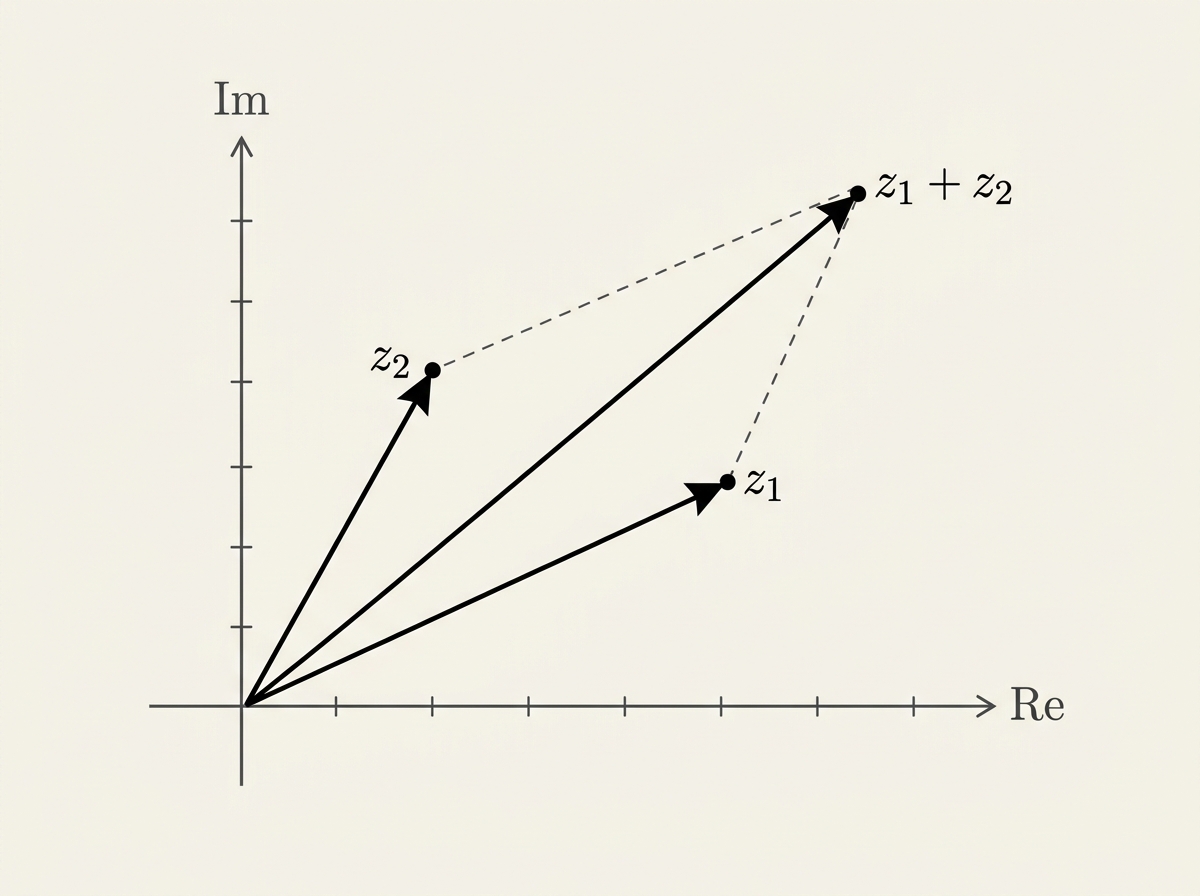
Since $z_1+z_2=(a_1+a_2)+(b_1+b_2)i$ adds components exactly like vectors, the sum $z_1+z_2$ is found geometrically using the same parallelogram (tip-to-tail) rule as vector addition. Subtraction $z_1-z_2$ corresponds to the vector from the point $z_2$ to the point $z_1$.
$z_1+z_2=3+5i$. On the Argand diagram, this point is the fourth vertex of the parallelogram formed by $O$, $z_1$, and $z_2$ — reached by moving from the origin along $z_1$, then along a vector equal and parallel to $z_2$ (or vice versa).
Modulus and argument
The modulus of $z=a+bi$ is its distance from the origin: $$|z|=\sqrt{a^2+b^2}$$ Note that $|z|^2=a^2+b^2=zz^*$, connecting the modulus directly to the conjugate.
The argument of $z$ is the angle $\theta=\arg(z)$ measured anticlockwise from the positive real axis to the line $Oz$. The principal argument is the unique value satisfying $-\pi<\theta\leq\pi$ (equivalently $-180°<\theta\leq180°$). It is found using $\tan\theta=\dfrac{b}{a}$, with the correct quadrant chosen by inspecting the signs of $a$ and $b$ — a calculator's $\tan^{-1}$ alone will not always give the right quadrant.
$|z|=\sqrt{9+16}=\sqrt{25}=5$.
$\tan\theta=\dfrac43$, and since $a=3>0,\ b=4>0$, $z$ lies in the first quadrant, so $\theta=\tan^{-1}\left(\dfrac43\right)=0.927$ radians (3 s.f.).
$a=-2<0,\ b=3>0$, so $z$ lies in the second quadrant, and $\theta$ should lie between $\tfrac{\pi}{2}$ and $\pi$.
The reference angle is $\tan^{-1}\left(\dfrac{3}{2}\right)=0.983$ radians. Since we're in the second quadrant, $\theta=\pi-0.983=2.16$ radians (3 s.f.).
$a=-5<0,\ b=-5<0$, so $z$ lies in the third quadrant. The principal argument must be negative, in the range $(-\pi,-\tfrac{\pi}{2})$.
Reference angle: $\tan^{-1}\left(\dfrac{5}{5}\right)=\dfrac{\pi}{4}$. Since we're in the third quadrant (measuring below the negative real axis), $\theta=-\left(\pi-\dfrac{\pi}{4}\right)=-\dfrac{3\pi}{4}$.
Always sketch a quick Argand diagram before calculating the argument. This makes it immediate which quadrant $z$ lies in, and prevents the extremely common error of quoting a calculator's raw $\tan^{-1}$ output (which is always between $-\tfrac{\pi}{2}$ and $\tfrac{\pi}{2}$) without adjusting for quadrants 2 and 3.
Exam-style questions
Question 1 5 marks
Find the modulus and argument (in radians, to 3 s.f. where appropriate) of $z=-6+8i$.
$|z|=\sqrt{36+64}=\sqrt{100}=10$ (M1, A1)
Second quadrant: reference angle $\tan^{-1}(8/6)=0.927$; $\theta=\pi-0.927=2.21$ radians (3 s.f.) (M1, A1, A1)
Question 2 6 marks
Given $z_1=1+i$ and $z_2=2-5i$, find $|z_1-z_2|$ and $\arg(z_1-z_2)$, giving the argument in radians to 3 s.f.
$z_1-z_2=(1-2)+(1-(-5))i=-1+6i$ (M1, A1)
$|z_1-z_2|=\sqrt{1+36}=\sqrt{37}$ (M1, A1)
Second quadrant: reference angle $\tan^{-1}(6)=1.406$; $\theta=\pi-1.406=1.74$ radians (3 s.f.) (M1, A1)
Question 3 5 marks
A complex number $z$ has $|z|=13$ and $\arg(z)=\pi+\tan^{-1}\left(\dfrac{5}{12}\right)$. Find $z$ in the form $a+bi$, where $a,b\in\mathbb{Z}$.
The argument is $\pi+\tan^{-1}(5/12)$, which places $z$ in the third quadrant with reference angle $\tan^{-1}(5/12)$ — matching a 5-12-13 right triangle. (M1, A1)
So $a=-12$, $b=-5$ (both negative, third quadrant, with $|z|=13$ confirming the 5-12-13 triple). (M1, A1, A1)
$z=-12-5i$.